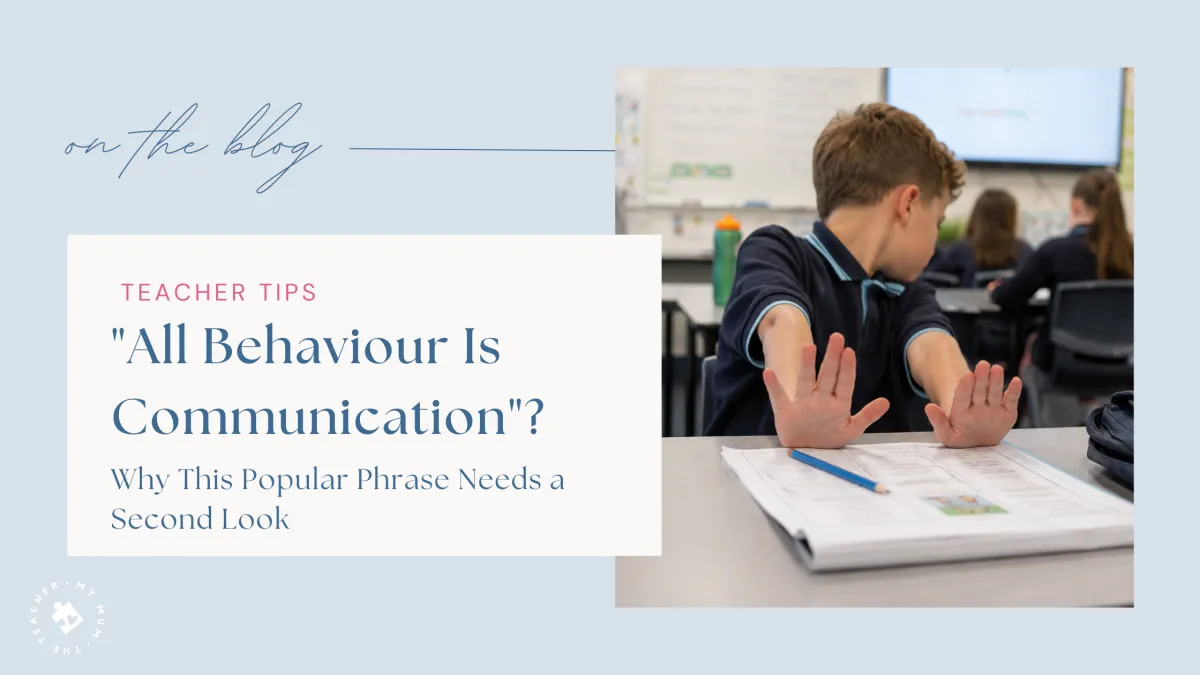
"All Behaviour Is Communication"? Why This Popular Phrase Needs a Second Look
"All Behaviour Is Communication"?
Why This Popular Phrase Needs a Second Look
I've just finished a full day of learning, and if you've spent any time in trauma-informed or inclusive education circles, you've heard it: all behaviour is communication.
It's become one of those phrases teachers reach for automatically — usually with good intentions. It reminds us not to jump to punishment, to look for the "why" behind a behaviour, to see the child, not just the incident.
But somewhere along the way, this phrase started doing more than reminding us to look deeper. In a lot of classrooms, it's quietly become a blanket excuse. And that's a problem — for teachers, for classroom culture, and honestly, for the students themselves.
Let's unpack why.
Where the Phrase Comes From
"All behaviour is communication" has roots in trauma-informed practice and disability support work, where it served a genuinely important purpose: pushing back against punitive, deficit-based responses to students with communication difficulties, trauma histories, or disability.
That origin matters, and the underlying idea isn't wrong. A student who can't yet name their frustration might show it through shutting down or acting out. A student overwhelmed by sensory input might communicate that overwhelm through behaviour long before they have the words for it.
The issue isn't the origin of the phrase. It's what's happened to it since — stretched, generalised, and applied to every behaviour, from every student, in every context, regardless of whether communication is actually what's happening.
The Real Distinction: Explanation vs. Justification
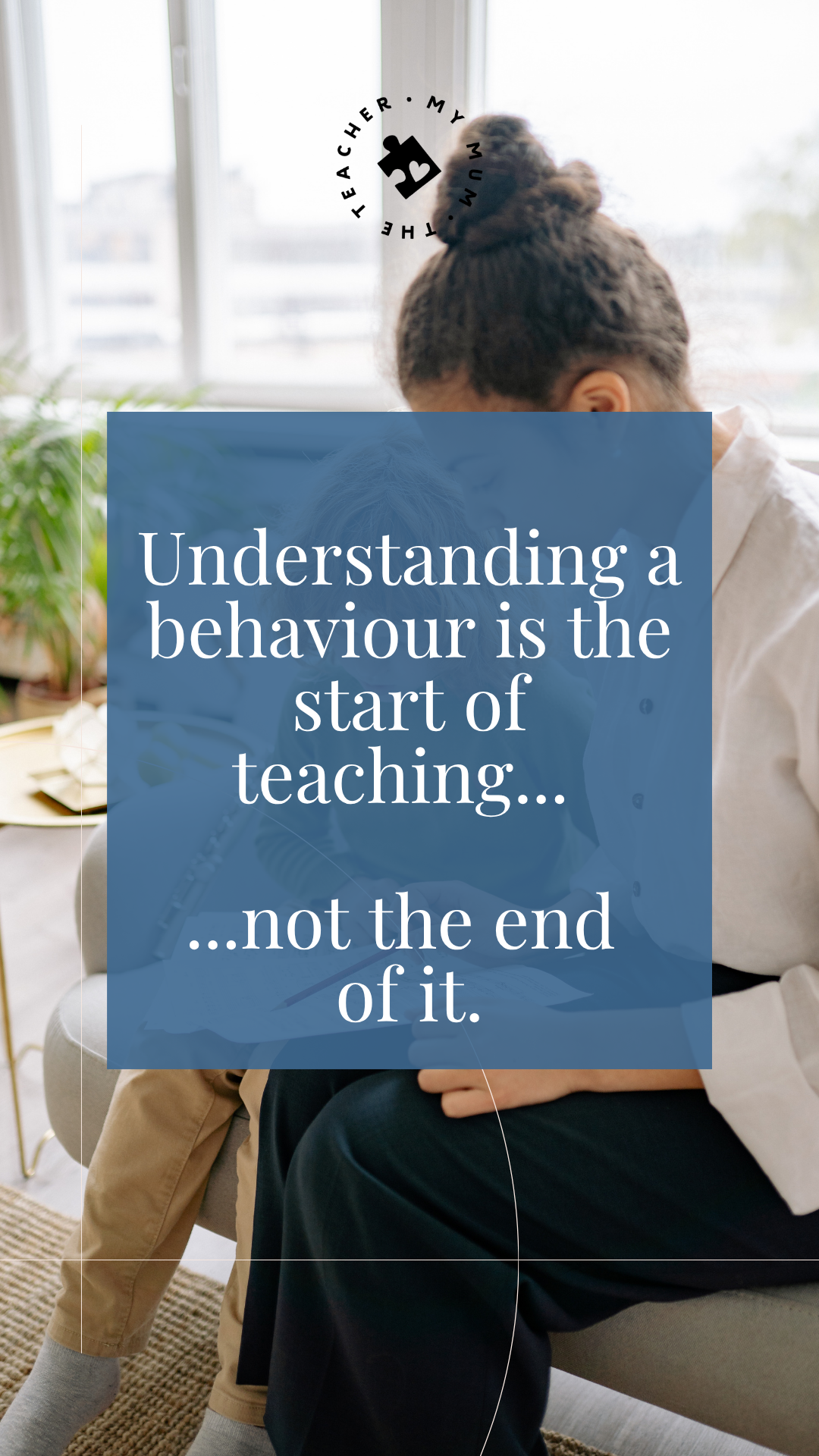
Here's the core issue, and it's worth sitting with: explaining a behaviour is not the same as justifying it.
This distinction isn't new, and it isn't limited to education. Philosopher Nigel Pleasants, writing on how we judge people's actions, notes that experimental research shows people who were asked to explain someone's harmful behaviour before judging it tended to judge that person more leniently than those who judged first and explained after. In other words, explanation does soften judgement — even when it isn't meant to excuse anything.
That's exactly why this distinction matters so much in classrooms. Historian Christopher Browning, writing about moral responsibility, put it plainly: explaining is not excusing, and understanding is not forgiving. Psychologist Philip Zimbardo made a similar point — understanding the situational factors behind someone's behaviour doesn't remove their responsibility for it.
Cognitive psychologist Steven Pinker goes further, warning that when we attribute behaviour entirely to something like the brain or a diagnosis, it can start to look like people are no longer being held accountable for their actions — turning a genuine explanation into what he memorably calls a "get-out-of-jail-free card."
None of these thinkers are arguing against empathy or understanding. They're making a sharper point: we can hold both truths at once. We can understand why a behaviour happened, and still expect the person to manage its impact on others.
Why This Matters for Students Too
This isn't just an accountability issue — it's also, somewhat counterintuitively, an inclusion issue.
When we default to "this is communication" for every behaviour, we risk two things going wrong at once:
We miss what's actually going on. Not every behaviour is a hidden message. Sometimes a student is tired. Sometimes they're testing a boundary. Sometimes — and this is the one that gets missed most often — there's an unaddressed medical, sensory, or cognitive need that "communication" framing quietly papers over instead of investigating.
We stop teaching the skill. If every difficult behaviour is reframed as valid communication rather than a moment for skill-building, students miss out on the explicit teaching they need: how to identify what they're feeling, how to ask for what they need in ways others can understand, and how to manage impact on people around them. Growth requires both understanding and expectation.
For those who have worked and lived with individuals with autism, ADHD, OCD, complex behavioural needs and other disorders and disabilities that impact daily functioning, it is clear that the tension shows up constantly in real settings: people can be genuinely struggling with something related to their diagnosis, while still not being exempt from the impact of their actions on others. I know before my son was diagnosed and medicated, we would make him write apology letters and apology to people face-to-face to ensure that he understood that while he couldn't necessarily control his actions, he needed to realise that they impacted those around him. Holding a diagnosis, a trauma history, or a support need doesn't give you a pass or excuse for your behaviour — and pretending it does isn't actually respectful. It's avoidance.
What This Looks Like in Practice
So what does it look like to hold empathy and accountability at the same time? A few practical shifts:
Separate the "why" from the "what now." Understanding why a student threw their chair helps you plan support. It doesn't change the fact that the chair still needs to go back, and the impact on the classroom still needs to be addressed.
Ask "what does this student need to learn?" not just "what is this student trying to tell me?" Both questions matter. But only one of them leads to a plan for growth.
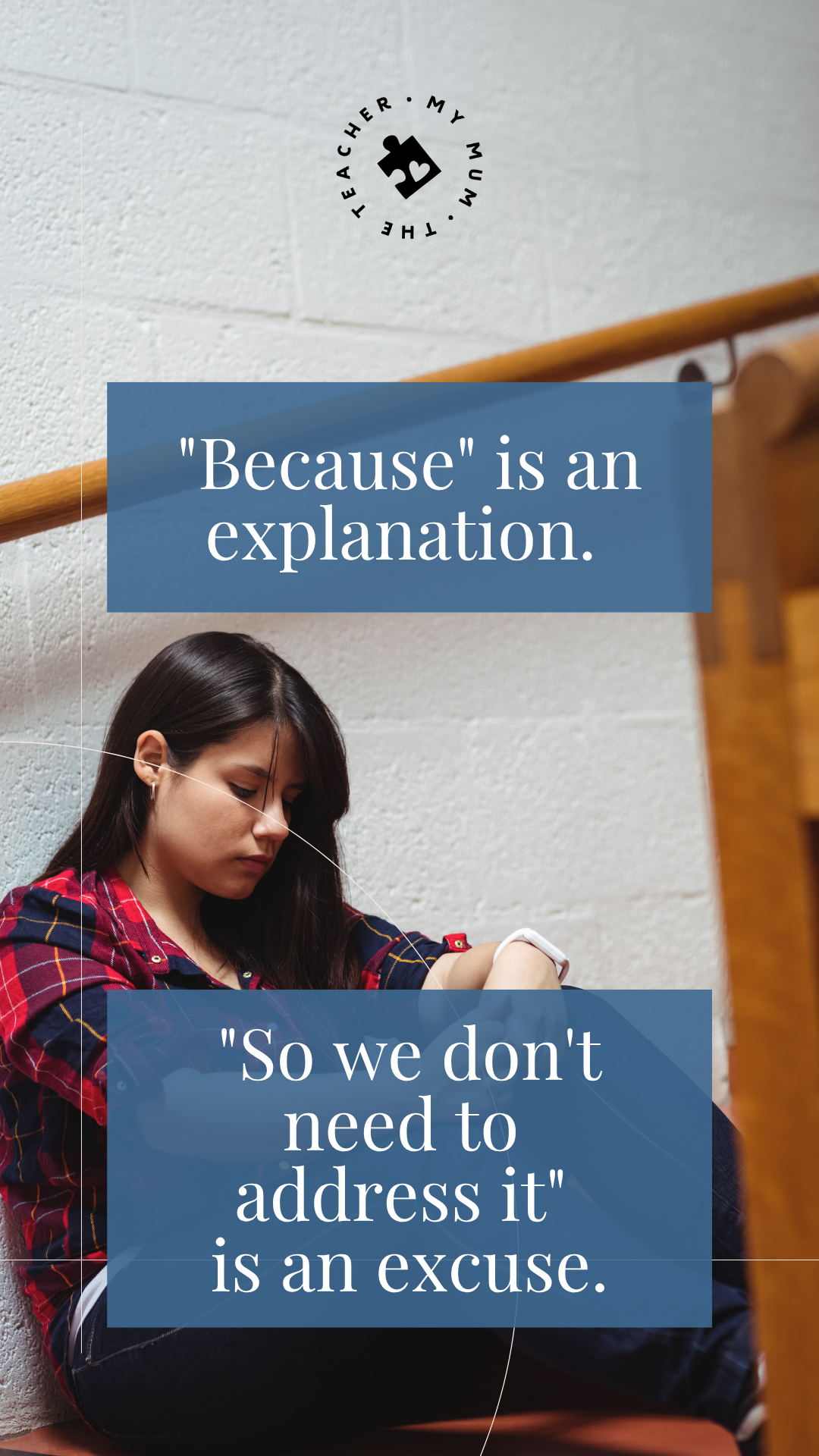
Watch for the words "because", "but" and "so." "He hit his desk because he was overwhelmed" is an explanation. "He hit his desk, but we won't address that" is where explanation quietly slides into excuse.
Keep expectations consistent, and keep support proportionate. A student can have a genuine, understood reason for a behaviour and still be expected to repair, reflect, and try a different strategy next time — with scaffolding suited to their needs.
Reserve formal behaviour analysis for behaviours that need it. Not every frown, sigh, or off-task moment requires a functional behaviour assessment. Over-analysing ordinary behaviour can be just as unhelpful as under-analysing a genuine support need — it pulls attention and resources away from the students who actually need that deeper investigation.
Holding the Line Without Losing the Empathy
None of this is a call to go back to zero-tolerance discipline or deficit-based views of students. That pendulum swing helps no one.
It's a call to be balanced, precise. Empathy and expectation aren't opposites — they work together. A student can be understood and still be responsible for how their actions affect others. In fact, that combination — genuine understanding paired with clear, consistent expectations —is what actually builds the self-regulation and social skills we want students to leave our classrooms with.
"All behaviour is communication" was never meant to be the end of the conversation. It was meant to be the start of one that also includes: and what do we do about it now?
Research & Further Reading
Pleasants, N. (2021). Excuse and justification: What's explanation and understanding got to do with it? — journals.sagepub.com
SimplyPsychology. When Is Autism Used As An Excuse And When Is It An Explanation? — simplypsychology.org
Psychology Fanatic. Breaking the Habit of Justifying Excuses (featuring Steven Pinker) — psychologyfanatic.com
LA Concierge Psychologist. Understanding the Difference Between Excuses and Explanations — laconciergepsychologist.com
Want more practical, evidence-informed strategies for balancing empathy and accountability in the classroom? Explore more resources at My Mum, the Teacher.


