Why are good spellers struggling?
Why Are Good Spellers Struggling?
Rethinking the Pace of Phonics
The day my good speller wrote "s-ch"
My son is a good speller. He always has been. He loves language, and loves reading. So when he wrote stomach as "schomic" recently, I stopped and looked again.
It wasn't a careless error. When I asked him to talk me through it, I realised what was happening. He was so worried about choosing the "right" letters for each sound that he had stopped actually sounding out the word. He was hunting through a mental list of letter-sound options instead of listening to the word and drawing on what he already knew.
And he isn't alone.
As I visit classrooms around NSW and Australia, I'm seeing students second-guess words that should be written without hesitation or confusion. In this post I want to unpack why I think that's happening, and what we can do about it.
What the data actually tells us
The national picture is more nuanced than the headlines suggest. NAPLAN primary spelling results have been broadly stable, and in NSW some cohorts have shown growth between Year 3 and Year 5.
But look a little closer and a pattern emerges that matches what many teachers see every day:
Students know the code but don't always apply it. Dr Tessa Daffern's analysis of 2,436 NSW Year 1 and 2 students found that strong spellers of one-syllable words made notably more errors in the middle of two-syllable words, such as monster and hundred. Many of these errors were missed or swapped sounds.
The gap persists into upper primary. Students in Years 3 to 6 spelled sounds in short words with high accuracy, but accuracy dropped sharply in the medial parts of longer words. Daffern links this to increased demand on phonological working memory.
Students are leaving primary without mastery. Students performing at the average were finishing primary school without having mastered the phonological, orthographic and morphological components of spelling. This is causing big issues for our secondary teachers, who are now required to adopt primary teaching curriculum to try and catch students up.
The secondary drop is consistent. Across every state and territory, the proportion of students meeting the minimum spelling benchmark fell between Year 7 and Year 9.
In other words, the problem isn't simply that students don't know their letter-sound combinations. It's that knowledge isn't becoming secure, automatic and transferable. That is exactly what happened with stomach.
Quantity over quality: the box-ticking problem
The shift to explicit, systematic synthetic phonics has been a positive one. I want to be clear about that. The problem I'm seeing isn't the approach. It's the pace.
When the new curriculum in NSW was introduced, I, like many, realised how tightly packed it was. The scope and sequence outlined a new grapheme or spelling pattern every day or two, a weekly spelling check, then on to the next unit - regardless of the whether students had mastered that grapheme or spelling pattern. On paper, it appears that the content has been "covered". But in reality, coverage and learning are not the same thing.
When the timetable drives the pace, a few things happen:
Review gets squeezed out to make room for new content
Students meet a pattern, practise it briefly, and move on before it's secure
Weekly tests measure short-term recall, not long-term retention
Students who need more repetition fall further behind each week
We end up with students who can tell you that "ch" can say /k/, but who can't reliably pull the right spelling for stomach when they're writing a story about lunch.
How phonics knowledge is meant to progress
Learning to spell isn't a list of codes to collect. It's a progression where each layer depends on the one beneath it being secure.
Phonemic awareness. Hearing, segmenting and blending the individual sounds in spoken words, without any letters at all.
Core grapheme-phoneme correspondences. The most common, most useful spelling for each sound, taught to automaticity.
Blending and segmenting with print. Applying that code fluently in short words, then in longer, multisyllabic words.
Alternative spellings and positional patterns. Learning that one sound can be spelled several ways, and that position in a word often signals the best bet (for example, "ay" at the end of a word, "ai" in the middle).
Morphology. Understanding meaningful word parts, such as prefixes, suffixes and roots, and how they affect spelling.
Word-specific memory. Securing the exact spelling of individual words so they can be retrieved without effort.
These layers overlap, and Daffern's research shows students can learn phonological, orthographic and morphological skills alongside each other from the early years. But overlapping is not the same as rushing. If step 3 isn't automatic, adding more and more options at step 4 creates confusion, not capability.
That's what I saw in my son. He had plenty of step 4 knowledge. What broke down was step 3: listening carefully to the word and segmenting it from start to finish.
How we got here: 50 years of spelling teaching
Ask most grandparents how they learned to spell and you'll hear the same story: a weekly list, copying, dictation and a Friday test. Today's students are asked to do something very different.
In a single generation, Australian classrooms have swung from memory-heavy word lists, to whole language, and now to systematic synthetic phonics.
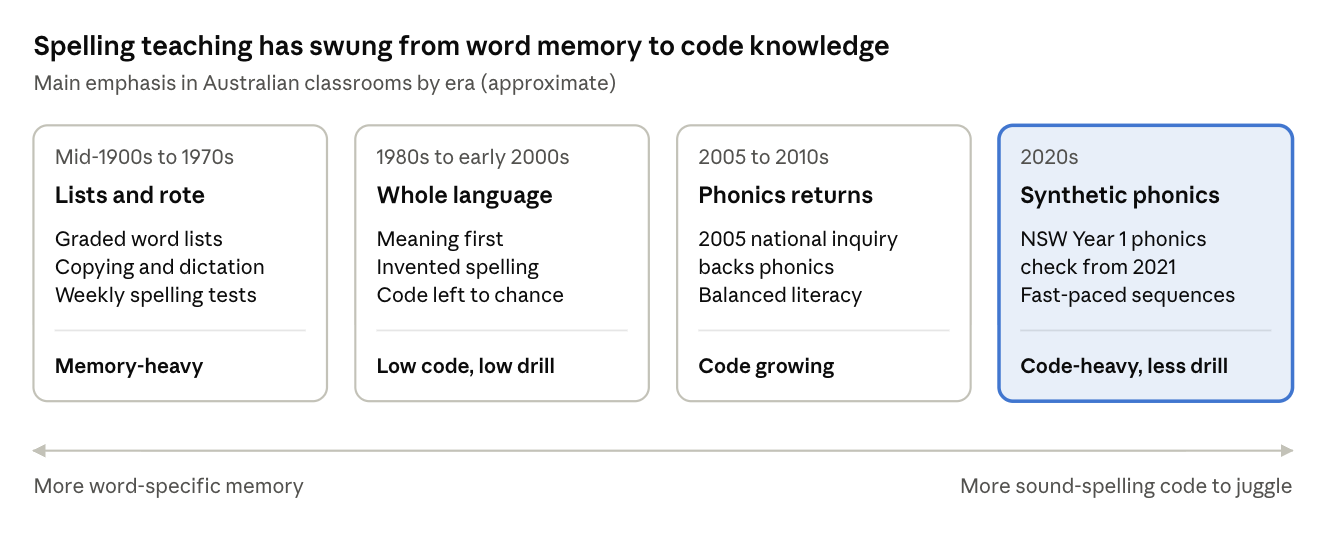
Each era fixed a real weakness in the one before it. The current one has brought the code back, but lost much of the repetition.
Then and now: what we ask students to do
Many of our elders | Many students today | |
|---|---|---|
Main strategy | Learn the word as a whole and remember it | Work the word out sound by sound, choosing from known spellings |
How words were practised | Lists, copying, dictation, frequent testing | Pattern of the week, sorting activities, decodable texts |
Role of memory | Central: words were drilled until they stuck | Often assumed to follow once the code is taught |
Sound-spelling options | Learned word by word, as they came up | Many taught explicitly, often in quick succession |
Pace | Slow and repetitive | Driven by the scope and sequence |
Older generations were rarely taught the full code explicitly. Some phonics was usually part of early reading, but spelling relied heavily on remembering specific words. They weren't asked to hold a chart of six ways to spell /ay/ in their heads while writing.
That approach had real limits. Students who struggled to memorise were often left behind, and few were taught why a word was spelled the way it was. The shift to explicit phonics was needed.
But in correcting one problem, we may have created another. We've added a great deal of code knowledge, and quietly removed much of the repetition that made words stick.
What a Year 2 student is expected to know now
By the end of Year 2, the NSW English syllabus expects students to use a large part of the English spelling code, and to explain some of it. That is a big step up from what most Year 2 students were asked to do 50 years ago.
The current expectations sit under two Stage 1 outcomes in the NSW English K–10 Syllabus (2022): Phonic knowledge (EN1-PHOKW-01) and Spelling (EN1-SPELL-01).
Year 2 then and now
Area | NSW syllabus: by the end of Year 2 (2022) | A typical Year 2 classroom, 1970s |
|---|---|---|
Word structure | Read and spell words with up to three consonants clustered at each end, such as splash and scrunch (CCCVCC) | Short regular words, practised as list words |
Vowel sounds | Extended vowel spellings, including vowel digraphs, trigraphs and quadgraphs, r-controlled vowels (car, bird) and diphthongs (boy, cow) | Common vowel patterns, mostly met word by word |
Less common spellings | Decode words with less common consonant spellings | Learned when a word containing them appeared on a list |
Longer words | Decode 2-syllable words with taught vowel spellings; segment words into syllables and sounds to spell | Rarely an explicit focus at this age |
Spelling rules | Explain that -tch and -dge follow a short vowel at the end of a base word, and apply it | Few rules taught explicitly |
Word parts (morphology) | Plurals, tense endings, -er for a person, -er and -est, -ful, -y, -ly, compound words, prefixes un-, re- and dis- | Plurals and simple endings, mostly through list words |
High-frequency words | Spell taught high-frequency words | Central: graded lists of common words |
How it was practised | Explicit lessons following a scope and sequence | Weekly lists, copying, dictation and testing |
What the comparison shows
More code, earlier. Today's Year 2 students are expected to know several ways to spell many vowel sounds. For example, /ay/ can be a, ai, ay, a_e, eigh or ey.
More reasoning, less remembering. The syllabus asks students to apply and explain patterns. Fifty years ago, students were mostly asked to remember specific words.
Two-syllable words have arrived in Year 2. That's exactly where Daffern's research found accuracy dropping, even for strong spellers.
None of these expectations are wrong in themselves. But each one adds to the load a 7-year-old carries while writing. Without time to consolidate, more code doesn't produce better spelling. It produces more options to second-guess.
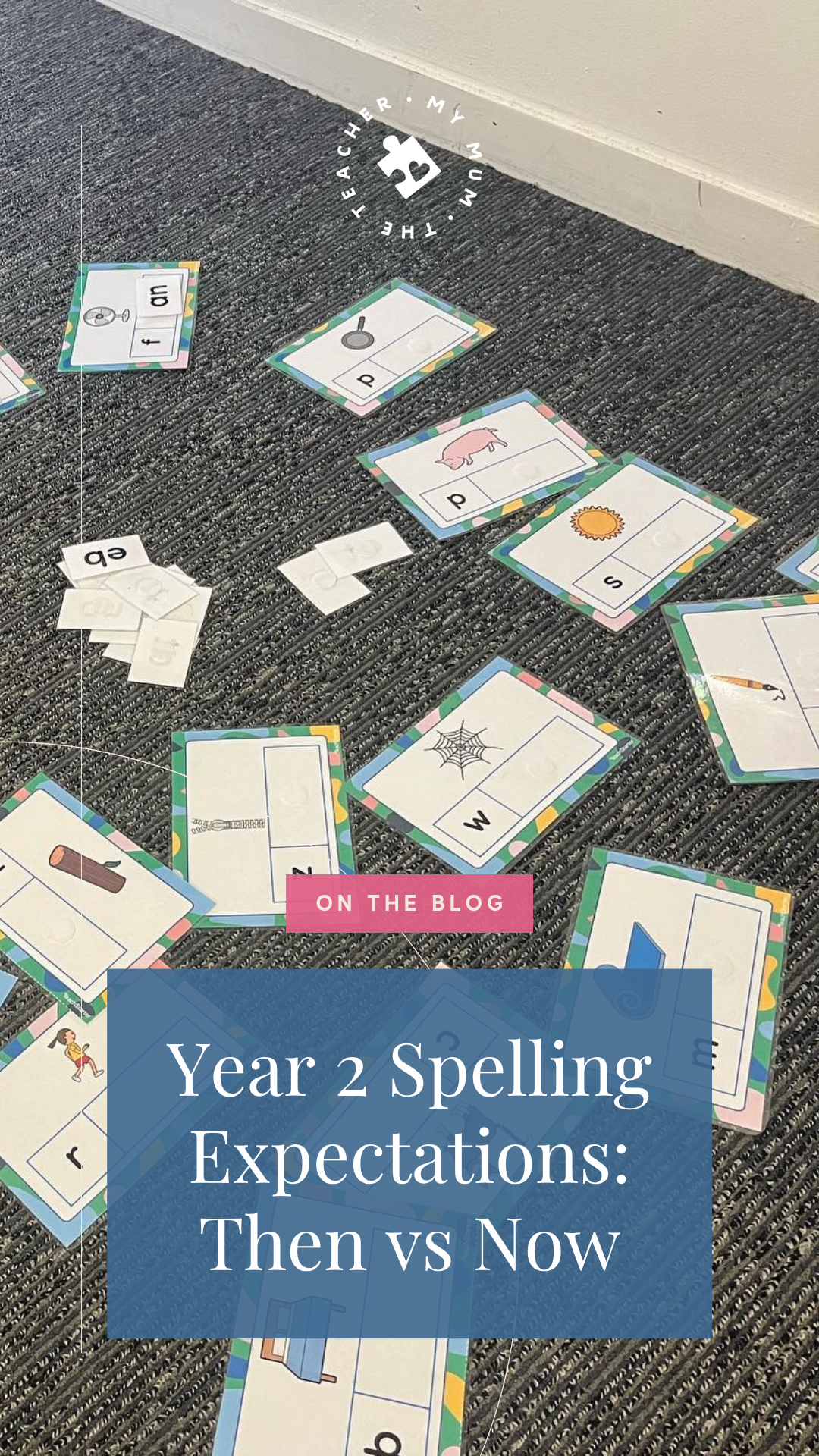
Overload: too many options, too soon
English has around 44 sounds and many more ways to spell them. Literacy specialist Lyn Stone has cautioned against relying on massive grapheme charts because they tax students' cognitive load rather than support it - I know I was overwhelmed when I was given those posters! (I ended up creating simplified versions that we rotated through, and that students could access when needed).
Working memory is small. When a student is holding a word in mind, breaking it into sounds and then searching through five or six possible spellings for each sound, there is very little capacity left for the actual task.
This is what over-analysis looks like in practice:
The student stops saying the word aloud or in their head
They fixate on one tricky sound and lose track of the rest of the word
They insert spellings that are "possible" but not plausible
They become anxious, slower and less willing to attempt words
That last point matters.
A student who freezes before every word is not a student who is "careless" or "not trying".
Hesitation is communication.
It's telling us the load is too high.
Slowing down the introduction of alternatives, and teaching them in context of the most frequent and useful patterns first, protects working memory for the thinking that matters.
The forgotten piece: memory
Phonics gives students the tools to work words out. But good spellers don't work out every word, every time. They retrieve it.
Professor Linnea Ehri's research on orthographic mapping explains how this happens. When students connect the sounds in a spoken word to the letters that represent them, the spelling is bonded to the word's pronunciation and meaning in long-term memory. Repeated, accurate encounters strengthen that bond until the word can be read and spelled without effort.
Two things are worth highlighting here:
Mapping relies on phonics, not visual memory. Most of us don't store words as pictures. The letter-sound connections are what make a spelling "stick", including for irregular words.
Mapping needs repetition. One lesson on "ch" as /k/ will not secure stomach, school and echo. Multiple, spaced opportunities to say, segment, write and check those words will.
This is where I think we've swung too far. In moving away from old-style "learn your list" approaches, many classrooms have also moved away from deliberate repetition and retrieval.
But repetition was never the problem.
Repetition without understanding was.
The research on learning is clear - retrieval practice (recalling from memory rather than re-reading) and spaced practice (revisiting over days and weeks) build durable learning. These belong in our spelling routines, alongside explicit phonics, not instead of it.
What special education taught me
In special education settings, we follow what our mainstream colleagues are doing, but we adjust it. We use explicit teaching and synthetic phonics. We also:
Slow the pace so each pattern has time to become secure
Introduce fewer new elements at once
Build in daily repetition and review of what's already been taught
Use rote learning deliberately for students whose learning profiles mean that working out every word from scratch isn't realistic or sustainable
Here's what struck me. Many of the students I taught were better spellers of familiar, high-use words than their same-age peers in mainstream classes.
I fully acknowledge there is a ceiling for some students, and the goals in a support class are individualised. But that observation has stayed with me. Students with significant learning needs, given time, repetition and a manageable load, were securing words in long-term memory. Meanwhile, capable students moving at full speed were not.
To me, that says the issue isn't the students' ability. It's the conditions we're asking them to learn in.
This is Universal Design for Learning in action. What is essential for some students (slower pace, repetition, reduced load) is often beneficial for all of them.
What we can do: quality over quantity
You don't need a new program. These Tier 1 adjustments work within the scope and sequence you already use.
1. Pace by mastery, not by calendar
Check last week's pattern before introducing a new one. If most students can't spell those words in a quick dictation, pause and consolidate.
Treat the scope and sequence as an order to follow, not a deadline to meet. If you need to slow up, meet with your team/stage leader and discuss your concerns. Student mastery should be the focus of any learning.
2. Lead with the "best bet"
Teach the most common spelling of a sound first, and make it automatic. This also allows your to differentiate for the different abilities in your class - students needing more practice can keep repeating, while those who have grasped it at the basic level can progress with more complex uses of the spelling.
Introduce alternatives gradually, with the words students actually use and need.
Keep reference charts small and targeted to what's been taught, rather than displaying every option at once.
3. Protect the say-it, segment-it step
Before writing, have students do the following:
Say It: say the word aloud
Map It: tap or count the sounds
Write It: write the word using sound boxes
Say It: say the word aloud again
Check It: check with a known source to ensure accuracy
This method engages the brain through auditory, visual and kinesthetic methods, giving more opportunities for knowledge to stick.
For longer words, chunk into syllables first (stom-ach), then segment each syllable. This directly targets the multisyllabic gap the research identifies.
4. Build in retrieval and spacing
Start each lesson with 3 to 5 minutes of mixed review from previous weeks.
Use short dictation sentences that recycle older patterns alongside new ones.
Revisit words a day later, a week later and a month later, not just on Friday's test.
5. Make repetition purposeful
Use repetition to secure high-use and personally important words.
Always pair it with the sound-letter connection ("say it, map it, write it, check it"), so students understand what they're memorising.
6. Support the anxious speller
Normalise mistakes as information. "That's a plausible choice. Let's check which one this word uses."
Model your own thinking aloud when you're unsure of a spelling.
Reduce the stakes: separate spelling practice from assessment, and give feedback on the parts of the word they got right first.
Differentiation at a glance
If a student... | Try... |
|---|---|
Hasn't secured core sounds | Smaller sets, daily review, multi-sensory practice (say, tap, write, say) |
Knows the code but | Explicit "say it first" routine, best-bet focus, syllable chunking |
Spells well in tests but not in writing | Spaced retrieval, dictation sentences, editing checklists with taught patterns |
Is ready for more | Morphology and word origins, such as Greek -ology or Latin -ion |
Slowing down is not falling behind
We have the right ingredients: explicit teaching, synthetic phonics and a clear sequence. What's missing is the time for learning to settle.
When we rush, we get students who know a lot about spelling but can't reliably spell. When we slow down, review often and use what we know about memory, we get students who spell with confidence, and who have the mental space left over to think about what they're writing.
My son doesn't need more letter-sound options. He needs to trust his ear and memory again, and to have enough practice that stomach is simply a word he knows.
So do many of our students.
References and further reading
Daffern, T. (2021). Exploring Australian Students' Spelling Skills: Spelling Skills Report 2021. Oxford Children's Language Australia.
Ehri, L. C. (2014). Orthographic mapping in the acquisition of sight word reading, spelling memory, and vocabulary learning. Scientific Studies of Reading, 18(1), 5–21.
Ehri, L. C. (2022). What teachers need to know and do to teach letter–sounds, phonemic awareness, word reading, and phonics. The Reading Teacher.
Stone, L. Spelling in a complex orthography: Can knowing better really help do better? OnLit webinar.
NSW Department of Education. NAPLAN results in NSW reveal promising signs.


